
How to handle this Proxmox certificate error “The remote certificate was rejected by the provided RemoteCertificateValidationCallback” with Veeam ?
After having research more information about this error RemoteCertificateValidationCallback, it’s linked to the way Veeam is handling SSL certificate of the Proxmox nodes. Veeam is storing a fingerprint of the certificate (self signed or not). When the SSL certificate is renewed (e.g. if you are automating SSL renew with ACME), then once the certificate is renewed, Veeam is not trusting the new certificate.
On this setup, we are running a 3 nodes Proxmox cluster with Veeam 13.0.1.180 (running on a Windows).
Due to the certificate issue, the vm’s are not visible anymore from Veeam.
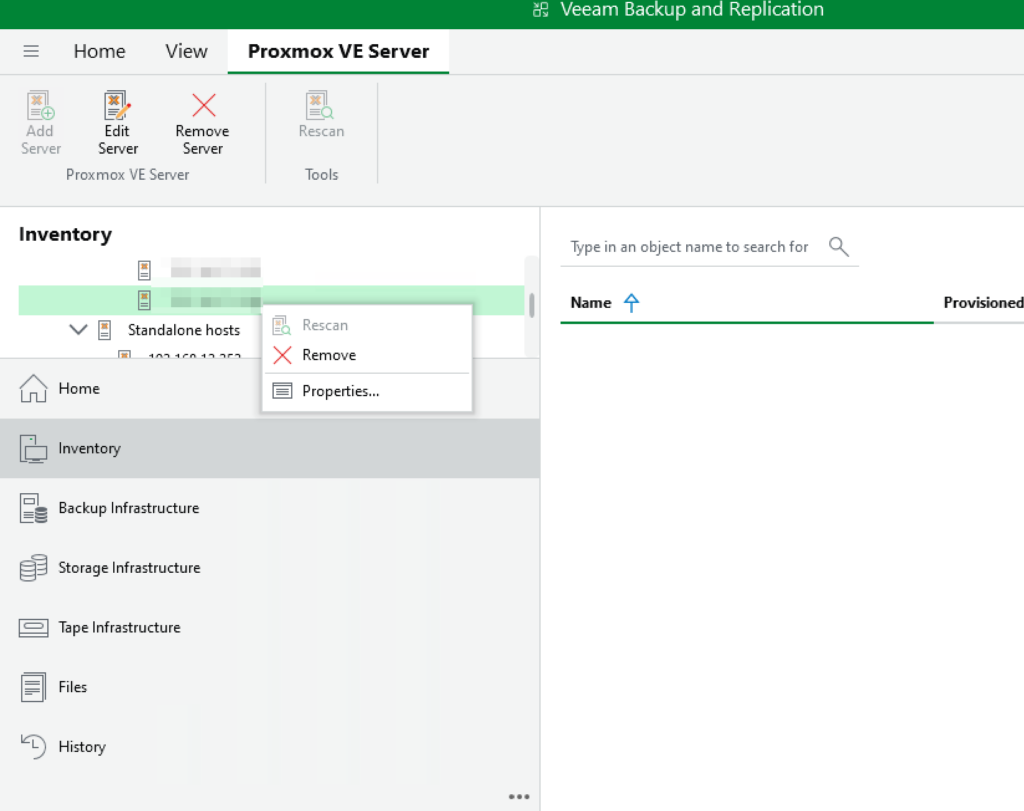
The fix is simple, Go to “Inventory” – “Properties”
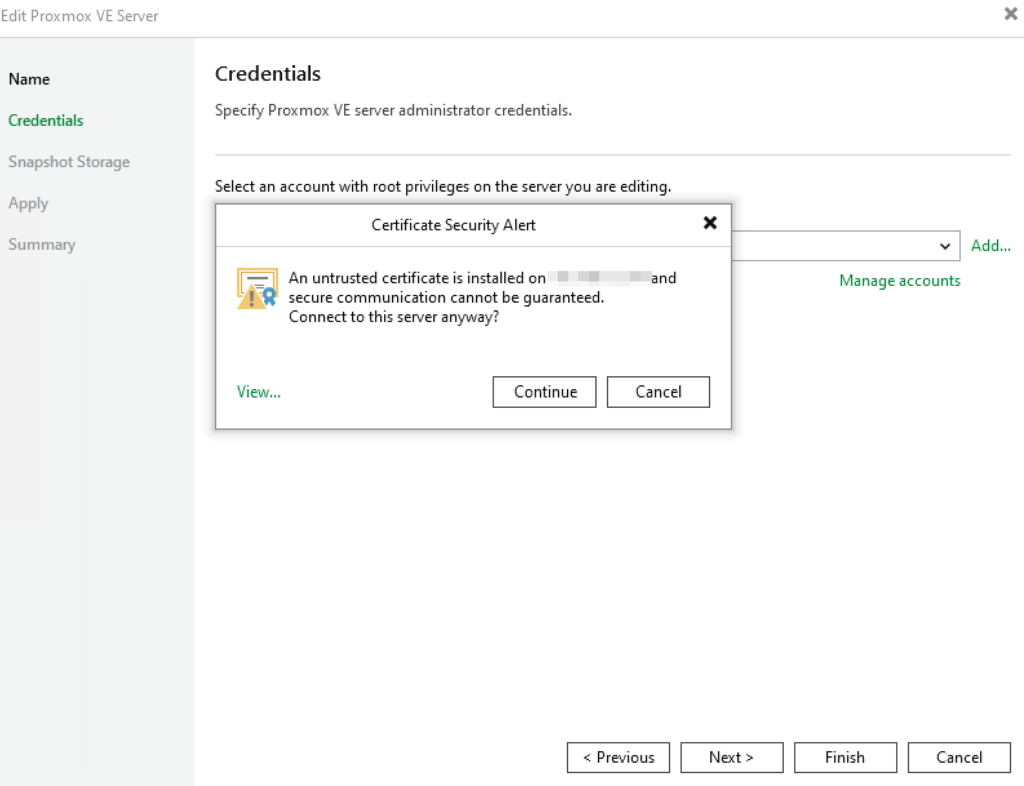
Run the Wizard, click on “View” to inspect and verify the certificate. You will probably notice that the certificate has been renewed and has a recent creation date. Click on “Continue”.
This issue should not happen if the certificate is trusted, in our case, we use a valid Let’s Encrypt certificate but Veeam is using the ip (in place of FQDN) to connect. Replacing the ip by FQDN will be done in the near future to avoid this problem. As the DNS servers are also virtual machines, we will probably hardcode the ip in the host file, to be able to restore vm’s in case of disaster (and where the DNS servers would also require restoration). This will be documented as exception.
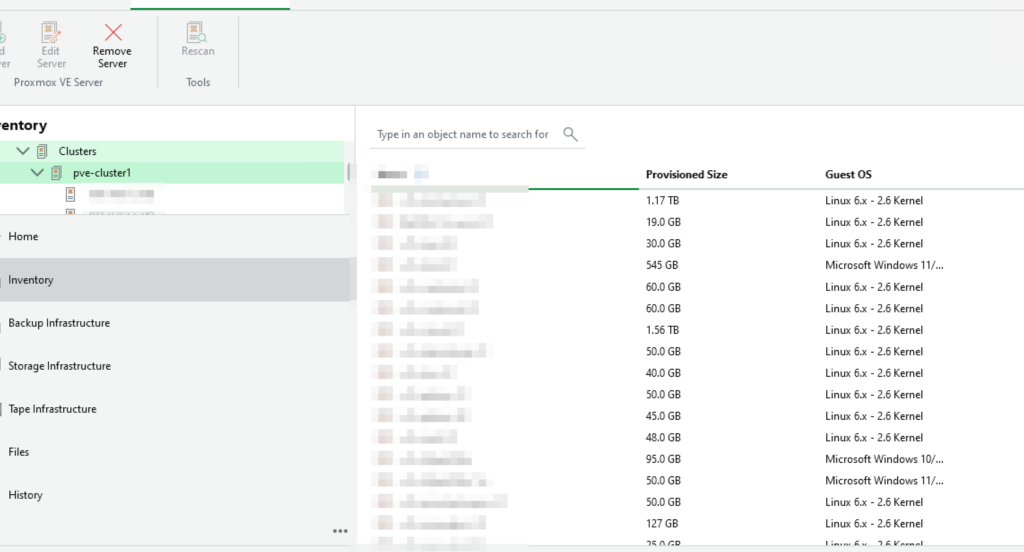
After this step, the virtual machines are visible again and the backups can start.
Proxmox Consulting with OFEP and Enterprise Backup Integration with Veeam
Proxmox Virtual Environment (VE) is an open‑source virtualization platform designed for modern data center and private cloud workloads. Built on KVM for virtual machines and LXC for containers, Proxmox VE delivers a unified platform that supports clustering, high availability, live migration, software‑defined storage, integrated networking, and role‑based access control. While Proxmox is technically powerful out of the box, enterprise adoption requires careful architecture, operational discipline, and integration with established data protection platforms. This is where professional Proxmox consulting and Veeam integration provide significant value.
The Role of Proxmox Consulting
Proxmox consulting focuses on designing, deploying, and operating Proxmox environments that meet enterprise requirements for performance, resilience, security, and scalability. Consultants assist with cluster sizing, node design, storage backend selection, and network topology, ensuring that workloads are distributed efficiently and that failure domains are clearly defined. This includes aligning Proxmox features such as high availability groups, fencing, quorum management, and live migration with real‑world operational constraints.
In addition, consulting services help organizations implement standardized configuration and lifecycle management practices. This includes patching strategies, access control models, logging, monitoring integration, and automation. Without this structure, Proxmox environments can become difficult to manage as they scale, increasing operational risk. A consulting‑led approach ensures that Proxmox is deployed as a long‑term platform rather than an experimental solution.
Enterprise Backup Requirements
For production environments, virtualization alone is not sufficient. Enterprises require predictable backup windows, defined recovery point objectives (RPO), fast recovery time objectives (RTO), and clear visibility into data protection status. Backup solutions must integrate with existing storage, security policies, and compliance frameworks, while supporting disaster recovery and ransomware resilience strategies.
Many organizations already rely on Veeam as their standard data protection platform. Integrating Proxmox with Veeam allows these organizations to extend established backup and recovery processes to Proxmox workloads without introducing additional tooling or operational silos.
Benefits of Integrating Proxmox with Veeam
The integration between Proxmox VE and Veeam enables centralized backup management across heterogeneous environments. Proxmox virtual machines can be protected using the same backup repositories, retention policies, monitoring, and reporting mechanisms used for other platforms. This simplifies administration and reduces the operational overhead of managing multiple backup systems.
From a technical perspective, Veeam provides storage‑efficient backups, flexible restore options, and strong visibility into backup health and compliance status. Recovery workflows can be standardized, allowing IT teams to restore entire virtual machines or individual files without relying on Proxmox‑specific tooling. This is particularly valuable in environments where service continuity and fast incident response are critical.
Security is another key advantage. Veeam’s support for immutable backups, monitoring, and alerting strengthens protection against accidental deletion, corruption, and ransomware. When combined with Proxmox security features such as role‑based access control and network segmentation, organizations gain a layered defense strategy that spans both infrastructure and data protection.
Maximizing Value Through Consulting
Proxmox consulting ensures that the Veeam integration is implemented correctly and efficiently. Consultants align backup architectures with storage performance, network capacity, and workload criticality. They also define backup scopes, retention periods, and recovery scenarios that reflect business priorities rather than generic defaults.
By combining Proxmox consulting with Veeam integration, organizations achieve a robust, enterprise‑ready virtualization platform backed by a mature and trusted data protection strategy. This approach enables cost‑effective infrastructure modernization while maintaining the reliability, security, and operational consistency expected in enterprise environments.